Immersive Video
Overgrown
A multichannel immersive video exploring the contrasts and parallels between urban and natural environments through three-screen projection.
A multichannel immersive video exploring the contrasts and parallels between urban and natural environments through three-screen projection.
Overgrown immerses viewers in contrasting scenes from urban and natural environments, highlighting both their differences and similarities. Energy and movement are conveyed through sound, motion, and scale, revealing moments of chaos in each space, as well as unexpected tranquillity that parallels the two spaces.
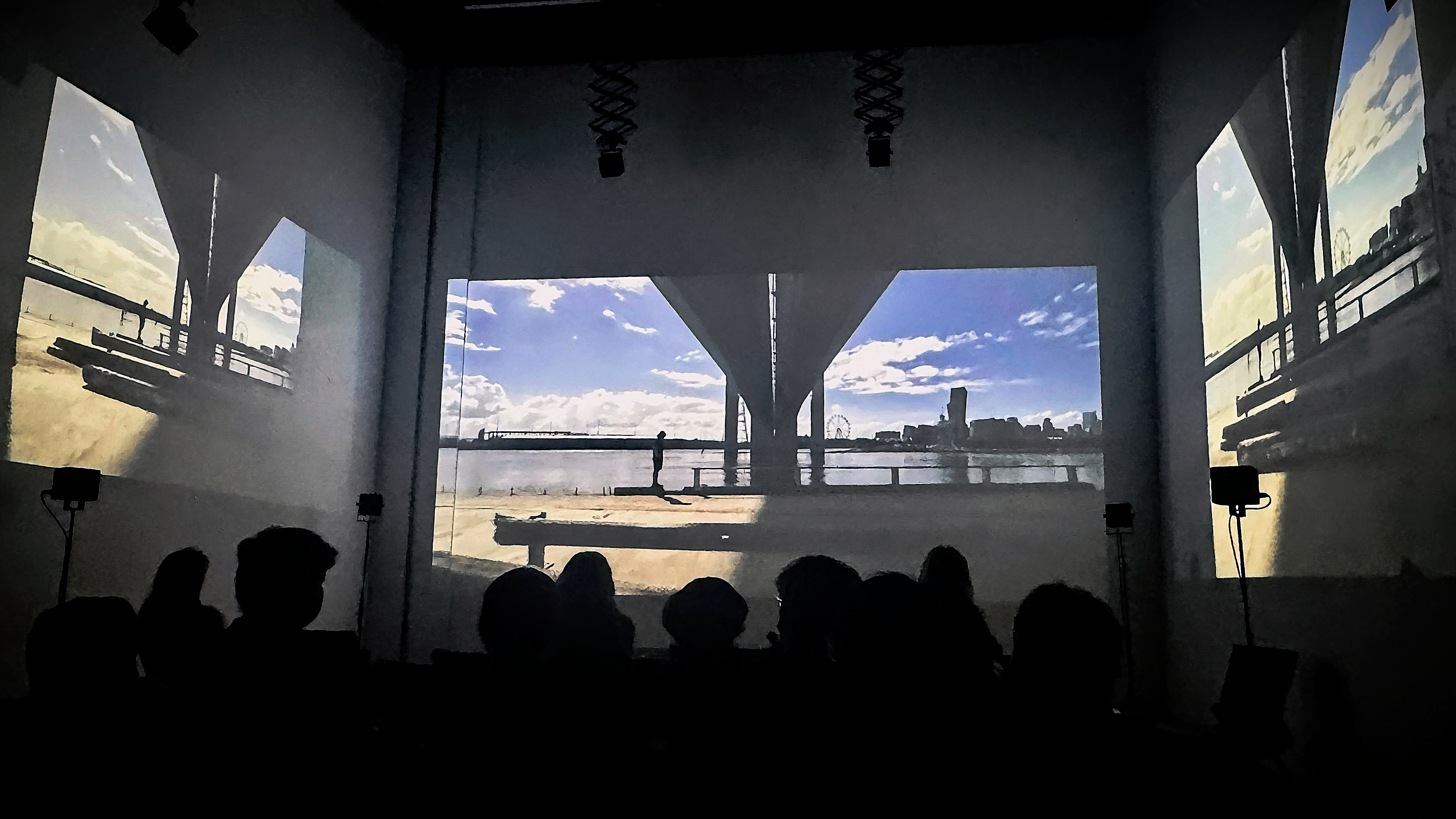
Overgrown is a short film created as a multichannel video, designed to be projected across three walls. The channels show varying visuals of natural and urban environments, utilising the three-screen projected medium through editing methods including repeating scenes across the three walls, using different angles of the same space and timing scenes differently to give the illusion of moving throughout each space across the screens. The film aims to create immersion through a variety of techniques focusing on time, scale, spatial choreography and point of view, and through considered technical decisions around camera work and sound.
Natural scenes and city scenes were filmed on a Panasonic Lumix DMC-GX85 paired with a Tamron 14-150mm lens. To gather natural imagery shots, a trip was taken to regional Victoria including Beechworth and Woolshed Falls, where various videos of streams, waterfalls and trees were taken. Timelapse shots feature clouds moving across the scene, with both planes and birds cutting across the screen, enhancing the themes of nature and civilisation. For some nature and city scenes, the wide end of the zoom lens was useful in capturing the scale of the environments. A closer zoom was used for some nature scenes, especially those of waterfalls and flowing water, to help capture more subtle details in the imagery. I used subjective shots within city scenes, including imagery from out-of-train windows, and walking throughout the city from a POV perspective.
Spatial choreography was explored in a few ways, a key example being the opening scene, filmed at Woolshed Falls. The scene was shot from two different angles walking down the same path to give visual consistency to the three scenes across the walls. The main video shows the perspective of looking straight up, while the side videos show angled videos of the same stretch of bush. By using this multichannel environment, I aimed to immerse the viewer in the moving spatial experience, allowing them to feel as though they are physically present in the space, while also maintaining spatial consistency for the viewer. Another example of this technique is the final scene, where three clips are combined to create a panoramic effect, to help mirror our natural field of vision and achieve increased immersivity. I additionally focused on editing scenes to be timed as if movement is going across three screens, where it is most effectively achieved in clips where vehicles or structures are moving across the three screens.
The rhythm and pacing of the video are key aspects. By pairing calm urban moments with tranquil nature scenes and conversely showing intense city scenes and chaotic nature scenes juxtaposed against each other, I aimed to draw attention to how presence can relate to stillness, movement and sound immersion and can be felt in vastly contrasting environments.
Conceptual influence is taken from Koyaanisqatsi, a film directed by Godfrey Reggio. This non-narrative documentary film depicts the different aspects of the relationship between humans, nature and technology. The film cuts between time-lapses and slow pans from natural scenes to scenes of man-made systems, drawing parallels between the two. This work inspires my project in its themes of nature and urban civilisation. The juxtaposition between different scenes creates a powerful feeling of reflection on humanity's effect on the planet. I edited my film to allow some scenes more space to breathe such as the cloud timelapses and waterfall footage, taking influence from the long scenes in Koyaanisqatsi which encourage the viewer to immerse themselves fully within each scene.
The final presentation was a rewarding culmination of this work, being able to see the panoramic effect of the three screens simultaneously. The film explores themes of nature vs urban environments through the use of time, scale, spatial choreography and presence to achieve an immersive video experience.
I'm always open to discussing new projects, creative ideas, or opportunities to be part of your vision.